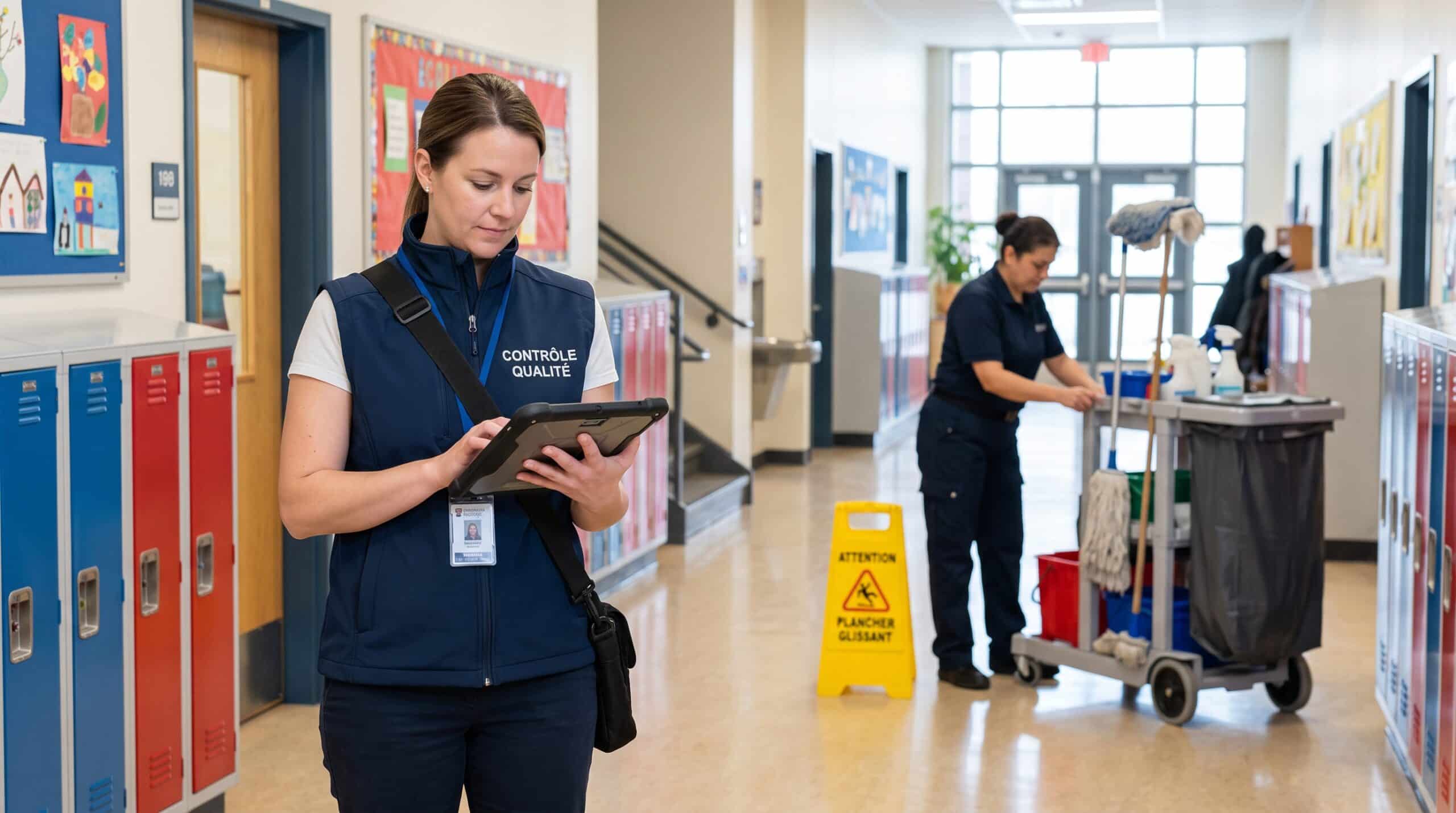

How can you actually improve the quality of your housekeeping without having to do it yourself? There are a few essential keys. All five keys are equally important.
Here is THE best household cleaning recipe!
1. A complete maintenance quote

personalized housekeeping quote THE housekeeping quote Includes all work to be completed over the next 3 to 5 years. The estimate ensures that all flooring, wall coverings, glazing, and building structures are cleaned according to instructions. It will also include all areas of the building, specifying all planned maintenance operations.
- This document should also serve as a quality control form, which we will see later in this article.
- Also plan for any work that may need to be done multiple times a day. For example, cafeterias, restrooms, showers, entrances, and meeting rooms may need to be inspected multiple times a day, depending on the building's traffic, the type of dirt, planned activities, etc.
- When it comes to floors, different cleaning schedules are required depending on the type of flooring. Make sure you have a good maintenance plan for the type of flooring you have.
- The estimate should be reviewed annually to ensure that it meets all requirements based on any changes that may have taken place.
2. Work routes per employee per building
Just as important as the estimate, the work schedule breaks down all the tasks to be completed, by building sector and by employee. It's essential that work schedules are balanced between each employee and between each day. In other words, you need to ensure that your workload is equal on each day to avoid frustration. Otherwise, you risk higher absenteeism on busy days.
It's not mandatory, but personally I like visual work routes with clearly defined tasks in concise language. No unnecessary blah blah! This isn't a novel; the text should be easy to read and very short. Also, avoid repetition or redundancy in the text. Refrain from paragraph-heavy texts.
There work route could be hung on the cleaning trolley, in a plastic bag or displayed in all the cleaning rooms. But depending on the number of employees you have, the display in the premises could be reduced to a binder. And at the same time, the work route must be easily accessible.
Work routes should be calculated by an experienced person. Since it's not about dividing the building into numbers of employees, it's about allocating the necessary time to each room based on its complexity. For example, a shower room versus a staircase, even if the space has the same surface area, the work time will not be equivalent.
3. Training

Once the quote and the routes are ready, it's time to move on to the training section. Because even if you have the most beautiful work routes, without training, it won't amount to anything!
Proper housekeeping training lasts from one day to two weeks, depending on the skill level of the employees and the required level. Depending on the division of labor performed in point 2, not all employees will be scrubbing and stripping floors. Not all will be doing major cleaning tasks such as washing windows, carpets, etc. Therefore, some of your workers will need more training than others. Keep in mind, however, that the more trained an employee is, the more versatile and important they become to the building.
For a basic training, try to promote a curriculum that covers the following points, including a practical part:
- The roles and responsibilities of each person (manager, supervisor, team leader, employee. An introduction to the concept of work routes would also be important.
- Explain the chain of transmission of bacteria and viruses as well as ways to protect yourself.
- See the work techniques (cleaning effectively, disinfection, dusting, color coding, use of microfiber cloths, the pre-soaking technique, etc.)
- Understand the different household cleaning products. Products should also be reviewed to focus on what's important. Too much product can confuse employees and cause health and safety issues.
- To introduce the accessories and equipment available, their handling and maintenance
- The effective use of the housekeeping trolley
- Llayout of the housekeeping room
- The organization of the work
- Etc.
- Plan for employee interaction throughout the training to ensure their understanding. And finish with a practical demonstration of the techniques.
4. Quality control of the work

Managers often think that the first three topics are more than enough, but no! Like any other training, a person won't remember all the points. I encourage employees to participate in training through exercises throughout the day. They have a training book with pictures reminding them of the techniques learned. And they also have the work routes as a reminder. To support all of this, it is necessary to quality controlImagine yourself in your own home. Could you assure me that every room has been thoroughly cleaned? Have you bothered to check? Unfortunately, this is where managers fail; they don't check the work unless they receive complaints of dissatisfaction.
THE quality control must be done randomly on all work routes: never at the same time or on the same day. And by changing the sampling. Whether the employee is among the best, or among the worst, it doesn't matter! The sampling should be equal for all employees.
This task should be carried out by an experienced person who can truly assess the issues raised and at the same time provide solutions. Which brings me to my last point.
5. Refresher training and feedback

During the quality control process, you will identify a few non-conformities that you will record in a quality control document. Whenever possible, I suggest documenting the results. This will allow you to track trends, improvements, or deteriorations. You will also be able to identify non-conformities that were clearly not fully understood during training. You can then take the opportunity to conduct a short refresher training session. This can last from 5 to 15 minutes. However, it will allow the employee to continually improve.
Quality control is also a great way to congratulate a deserving employee. You could even use quality control to reward high monthly scores, for example! The important thing is to keep employee motivation "alive." So, take this opportunity to also highlight the positive aspects of what was done well along the employee's work path.