In a public building, the manager must answer a simple question: is the maintenance budget being met? Not "more or less", but in a measurable way, week after week.
We have already explained Why, when, and how to perform quality control. This article goes further. It explains what distinguishes effective quality control from a simple inspection tour. Such control adheres to the specifications and respects the employee. Moreover, it has a single objective: to help the team improve.
A grid built from the quote
The starting point is the maintenance quote. In other words, we don't monitor according to our own preferences. Instead, we monitor what the specifications require, at the agreed frequency. This way, the monitoring remains fair for the employee and useful for the manager. Furthermore, if the building doesn't yet have a specifications document, CF Salubrité will prepare it for you.
A ranking by prototype
At CF Salubrité, we classify each room in the building by type. We call these types prototypes: office, classroom, corridor, toilet, changing room, cafeteria, production area, etc.
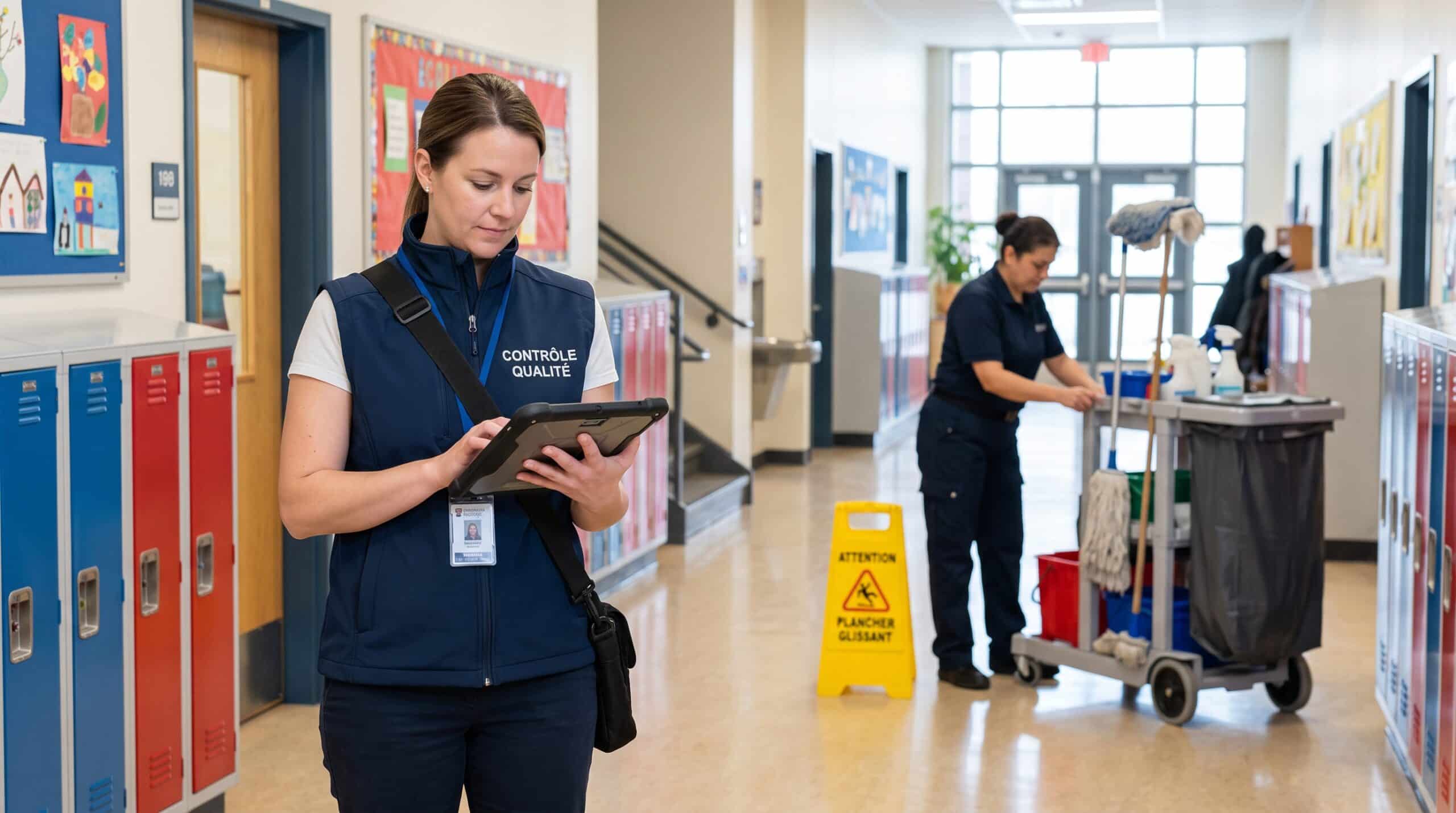
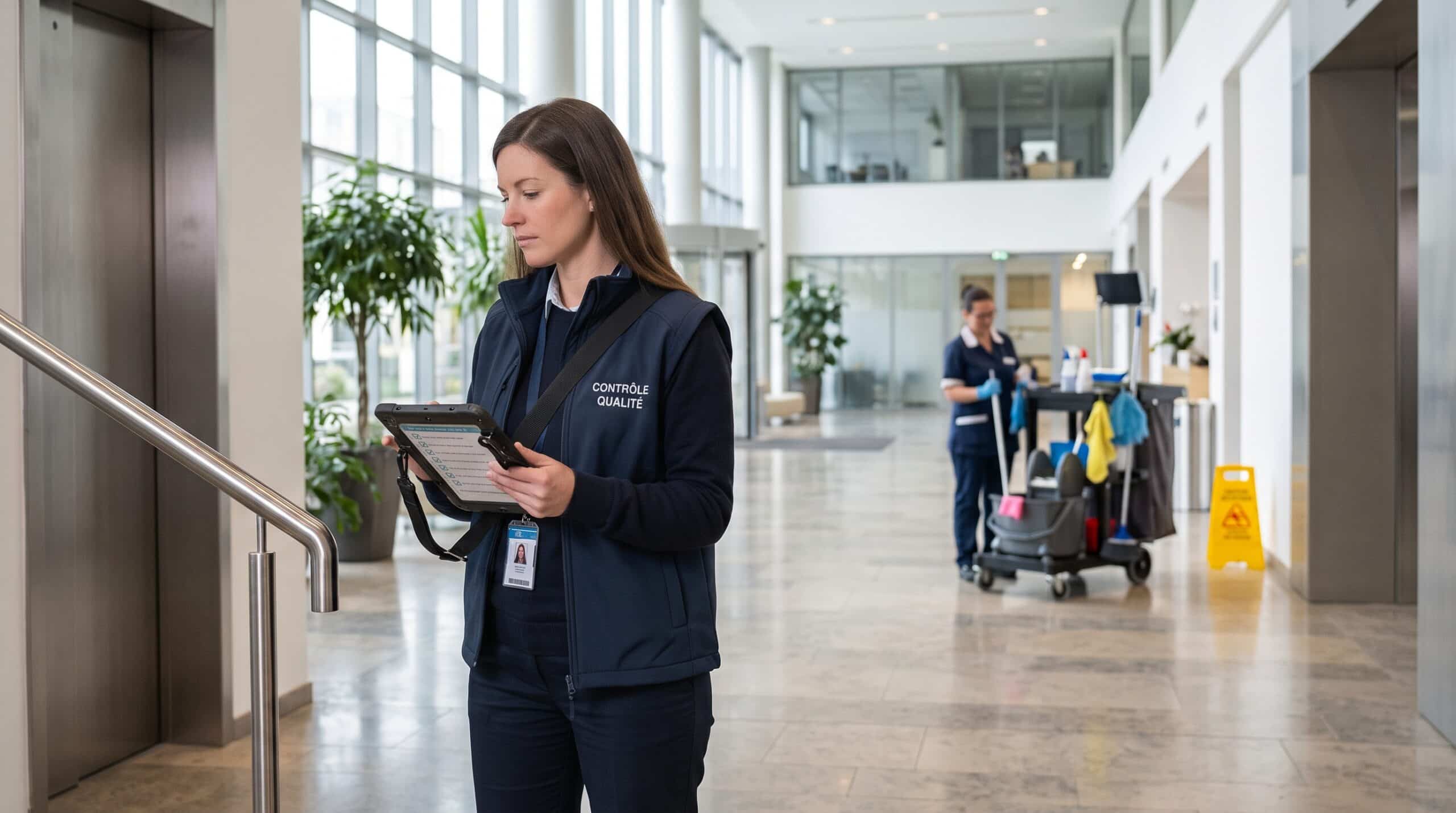
For each prototype, the checklist lists the points to be verified. Then, the inspector evaluates each point in the same way: compliant, needs improvement, or non-compliant.
A fair scoring system for everyone
This yields a score for each prototype. An overall score is also obtained for the entire building. Since all employees use the same checklist, the scoring remains consistent for everyone. Furthermore, the checks are carried out regularly in all areas, not just in the entrance hall.
Does the NQO reach the NQA?
The key question then becomes: does the achieved quality score (EQS) meet the expected quality score (EQS)? We establish the EQS in advance with the client, based on the building's requirements. For example, a restroom will not necessarily have the same EQS as a corridor. Therefore, during each site visit, we compare the EQS to the EQS. The difference between the two clearly indicates where to focus our efforts.
UV markers for high-risk contact points
Some surfaces appear clean to the naked eye. However, they are not always so. This is the case for high-risk contact points of contamination: door handles, light switches, handrails, faucets, elevator buttons, and toilet flush handles.
To verify these points, we use an invisible marker. First, we write a date on the surface. This date only appears under UV light. Then, at the next inspection, we illuminate the surface with a UV lamp. If the date has disappeared, the employee cleaned the surface. However, if it is still visible, the cleaning did not take place.
This method is simple and objective. It is particularly suitable for schools, changing rooms, toilets and high-traffic areas.
Photos and possible solutions
The inspector photographs each non-conformity. This way, the manager sees exactly what we observed, and so does the employee. The facts speak for themselves.
However, simply noting the problem isn't enough. For each non-conformity, the report therefore proposes a solution: the right product, the right technique, the right tool, or an adjustment to the routine. In fact, we've compiled several of these in our article on... common non-conformities and their possible solutions.
A clear report for management
After each visit, management receives a clear report. The manager doesn't have to review every single room. Instead, they receive a summary of priorities and key areas, organized by work route or employee. This allows them to know where to focus their efforts first.
If needed, the detailed prototype information remains available, including notes, photos, and comments. In short, it's a practical tool for contract tracking and internal decision-making.
Statistics: an overview
What good is a quality control form without statistics? Not much. Indeed, a single score doesn't tell you whether the situation is improving or deteriorating.
Quality control is therefore not just about evaluating a day's work. It also helps to identify key trends. Thanks to the results compiled visit after visit, the manager can:
- track the evolution of the ratings by prototype, by zone or for the entire building;
- identify recurring problems;
- to measure the effect of a training course, a product or a new method;
- to base its decisions and budget requests on concrete data.
Adjust the quote to reality
Statistics can also call into question the estimate itself. For example, a room might remain non-compliant despite a skilled and well-equipped employee. In this case, the frequency specified in the estimate may not be appropriate. Conversely, an area that is always spotless might require fewer visits.
Finally, for a public building, this data serves for accountability. It shows, with supporting figures, that maintenance is being carried out properly.
With respect for the employee, to help them improve
Quality control doesn't aim to catch employees in a mistake. On the contrary, it helps them improve. That's the whole difference between monitoring and supporting.
At CF Salubrité, feedback is given continuously, respectfully, and in a positive spirit. First, we highlight what is done well. Then, we explain what can be improved, with concrete suggestions. If necessary, we also provide an on-site demonstration.
Furthermore, we suggest coaching, which complements quality control. This involves an individual meeting with the employee. It allows for a review of areas for improvement and provides them with the tools to succeed.
In short, a recognized and encouraged employee progresses much faster than an employee who is monitored. We also discussed this in How to check that the quality of work is improving?
More than an inspection: support
In summary, effective quality control relies on several elements:
- a grid built from the quote;
- a regular frequency and an accurate score;
- UV marker checks;
- photos and possible solutions;
- statistics;
- respectful feedback.
It's this combination that delivers lasting results. At CF Salubrité, we don't just observe. Thanks to our training expertise, we support your teams visit after visit. Discover our housekeeping quality control service.
Do the statistics show a need common to the entire team? In that case, our group training They train all your employees at the same time. They focus on the specific points raised during the inspections. Also, see all of our housekeeping training.
Want to know the status of your building's maintenance? Contact us:
- 514-795-5962 (French)
- 514-730-1801 (Spanish)