Customized work routes are the foundation of well-organized housekeeping: each employee knows what to do, in what order, how often, and for how long. But how exactly are they prepared? Where do we start, and what do you receive at the end? Here, step by step, is how we develop work routes for your buildings.
If you're still wondering whether your team needs work routes, read our article first. Work routes: 5 signs your employees need them
A mandate that can take several forms
No two buildings are alike, nor do any two clients start from the same point. Some already have roads that need updating, others have never had any. Some have a precise quote, others none at all. That's why the project can take many forms: we start with your reality and your needs, not with a ready-made solution.
Step 1: The inventory
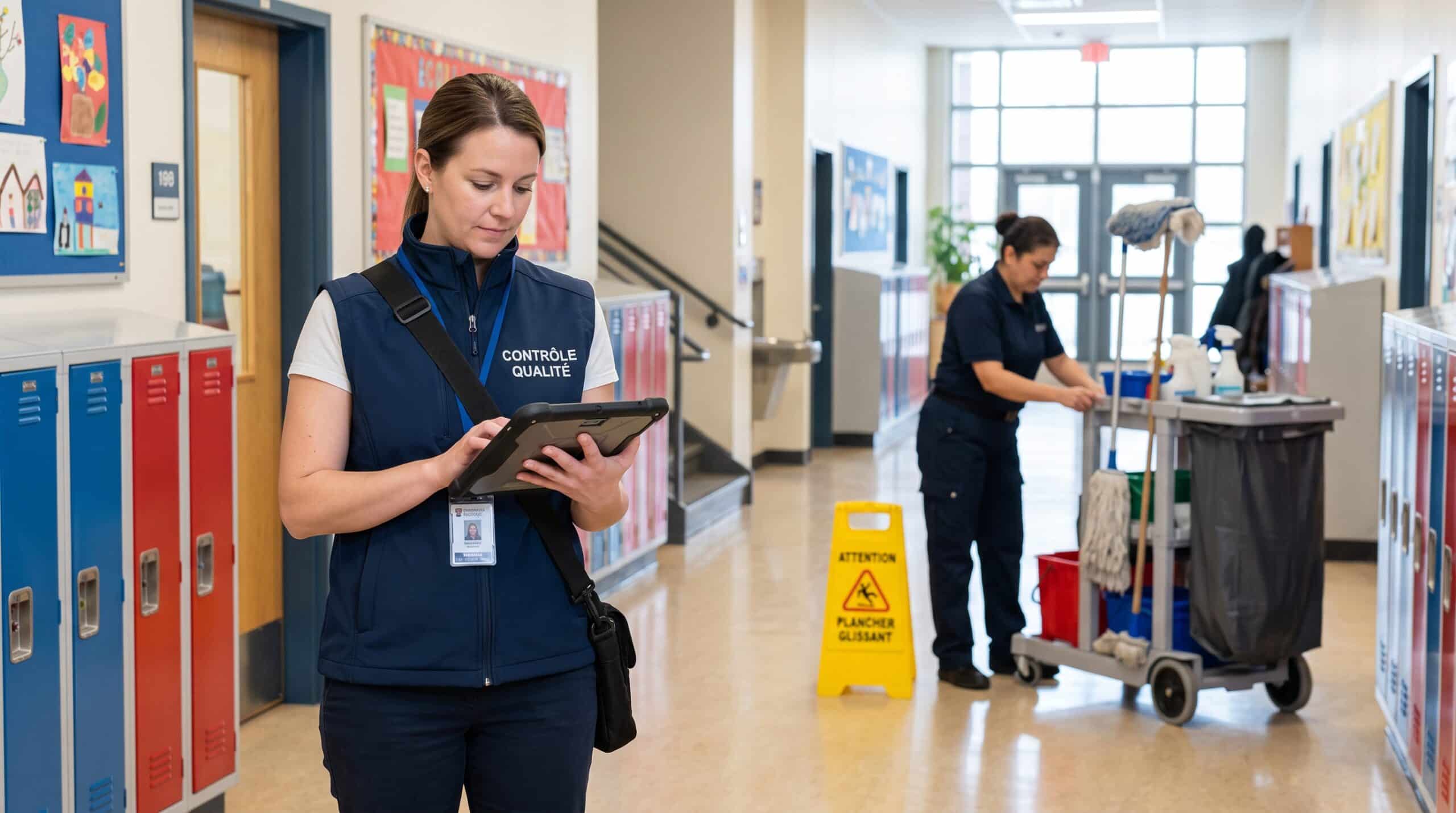
Before building anything, we begin with a complete assessment of the existing conditions, much like an initial quality control check. This assessment includes:
- The condition of the building, both indoors and outdoors.
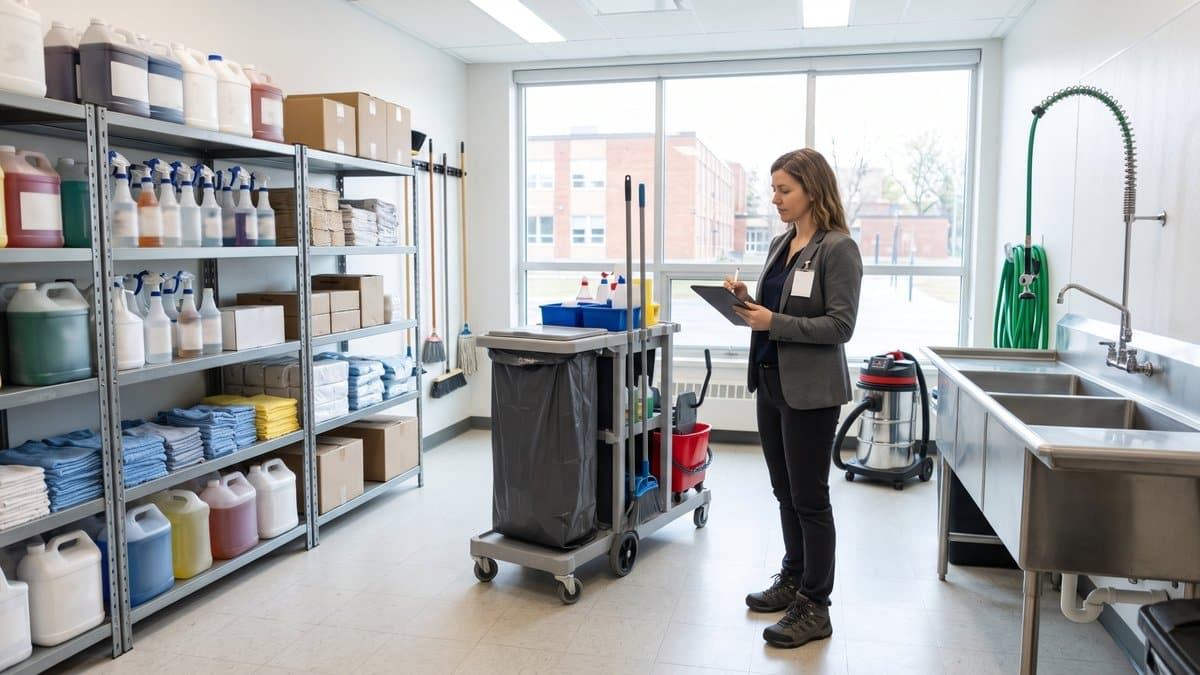
- Products and accessories available. A well-calculated route will not give the expected results if the cart is incomplete or if the products are not suitable for the surfaces.
- The available equipment, such as floor scrubbers, polishers and vacuum cleaners.
- The working methods used by your team.
- The condition of the housekeeping premises (concierge services) and their layout.
- Maintenance frequencies currently applied.
- Periodic work, which do not happen every day but must be planned.
- Problems and obstacles related to the building, such as traffic flow, the layout of the premises, or surfaces that are difficult to maintain.
- Investments to be expected, if applicable.
This visit is followed by a comprehensive site visit report. This provides you with a clear and objective overview of the initial situation, which will also serve as a point of comparison later on. To learn more about our evaluation method, please visit our page Quality control of housekeeping services
Step 2: Establishing priorities
From the moment we receive the site visit report, we provide you with priorities to establish. What's urgent? What can wait? Where will your efforts have the greatest impact? You don't have to tackle everything at once: you know where to start.
Step 3: A reasonable timeline
A reasonable timeline is then submitted to you. It outlines the next steps for improvement that we suggest.
This timeline is customized for each client following a site visit. It takes into account upcoming investments, planned renovations, and many other factors specific to your organization.
Step 4: Data collection in the field
Next comes the fieldwork. We visit each building, room by room, to gather all the necessary information:
- The measurements of the premises, to know the actual areas to be maintained.
- The prototype classification: Each room is associated with a type (office, bathroom, classroom, corridor, cafeteria, etc.), with its own tasks.
- Floor coverings and surfaces, which do not all require the same maintenance or the same amount of time.
- High-risk contact points, such as handles, switches and handrails.
- Maintenance frequencies, according to your quote. If you don't have one, we can prepare it with you.
- Your working hours and shifts, as well as the number of employees available.
Your cooperation will be necessary for data collection. For example, we will need your building plans and a clear understanding of your requirements. Data collection may take some time; this is essential for obtaining the most accurate routes possible.
Step 5: Calculating times according to industry standards
Each task is then costed. Routes are calculated according to industry standards (ISSA time standards), taking into account the type of premises, its area, the method used and the planned frequency.
We also comply with the decree applicable to your region: either the Montreal region decree or the Quebec City region decree. Breaks, shift lengths, and certain limits, such as backpack vacuum usage time in the Montreal region, are included in the calculation. For more information, please visit the website of the Joint Committee for Housekeeping Services. Montreal or of Quebec.
Customized work routes for your building
This is the most important point: the roads are calculated and completely customized to your building. Each building has specific needs. An elementary school, an arena, a town hall, a factory, or a seniors' residence do not have the same premises, the same traffic, or the same risks.
Even two similar buildings can require very different access routes: the age of the paving, traffic patterns, floor layout, or the location of the concierge's office all make a difference. That's why data collection is so important.
Step 6: Balanced and equitable roads
Once the times are calculated, the tasks are distributed among the employees. The goal: balanced and fair routes, where no one is overloaded while a colleague finishes early. The order of tasks also follows a logical path through the building, to avoid unnecessary backtracking.
Step 7: Illustrated, easy-to-follow routes
Each employee receives a clear, illustrated handover guide. Photos show high-risk contact points and the products, accessories, and equipment to use. This allows a new employee to become independent much more quickly, and ensures that a replacement knows exactly what to do.
The routes are written in French. Upon request, they can be translated into another language, so that each employee clearly understands what is expected of them.
Step 8: Presentation of routes and employee support
The routes are introduced to the employees. We take the time to present them, explain how they work, and answer questions.
Depending on the client's choice, we then prioritize employee support, especially during the initial months of route implementation. This follow-up ensures that everything runs smoothly for both employees and management.
If necessary, the routes are adjusted as part of this support, during the first weeks of their introduction.
Step 9: Training, to get back on track
A route, however well-maintained, yields better results when employees master the correct methods. That's why we suggest training to accompany the routes. It allows the entire team to start afresh with a solid foundation in housekeeping: the right products, the right techniques, and the correct work order.
The training can be delivered directly at your premises, using your products and equipment. To find out how it works, read the article on the CF Sanitation training course.
It's not magic: a human approach
Work processes, training, and quality control are the three key elements for successful maintenance. But implementing them isn't magic. We're managing human beings, and we must ensure we do so with compassion.
During employee support sessions, and particularly during quality control checks, we focus on only 2 or 3 points. This way, the employee is not overwhelmed: they are encouraged to improve continuously, one step at a time.
In summary
- A mandate tailored to your starting point.
- A complete assessment of the condition of the premises and a site visit report.
- Clear priorities and a reasonable timeline.
- Routes calculated according to industry standards and the applicable decree.
- Roads that are fully customized to your building, balanced and visually appealing.
- A presentation of the routes to employees and support during the first few months.
- A training program to get back on track.
Do you have questions about your work routes or want to know where to start? Contact us by phone or email. To learn more, visit our page on our work route planning service.
Looking forward to supporting you in your improvement efforts!