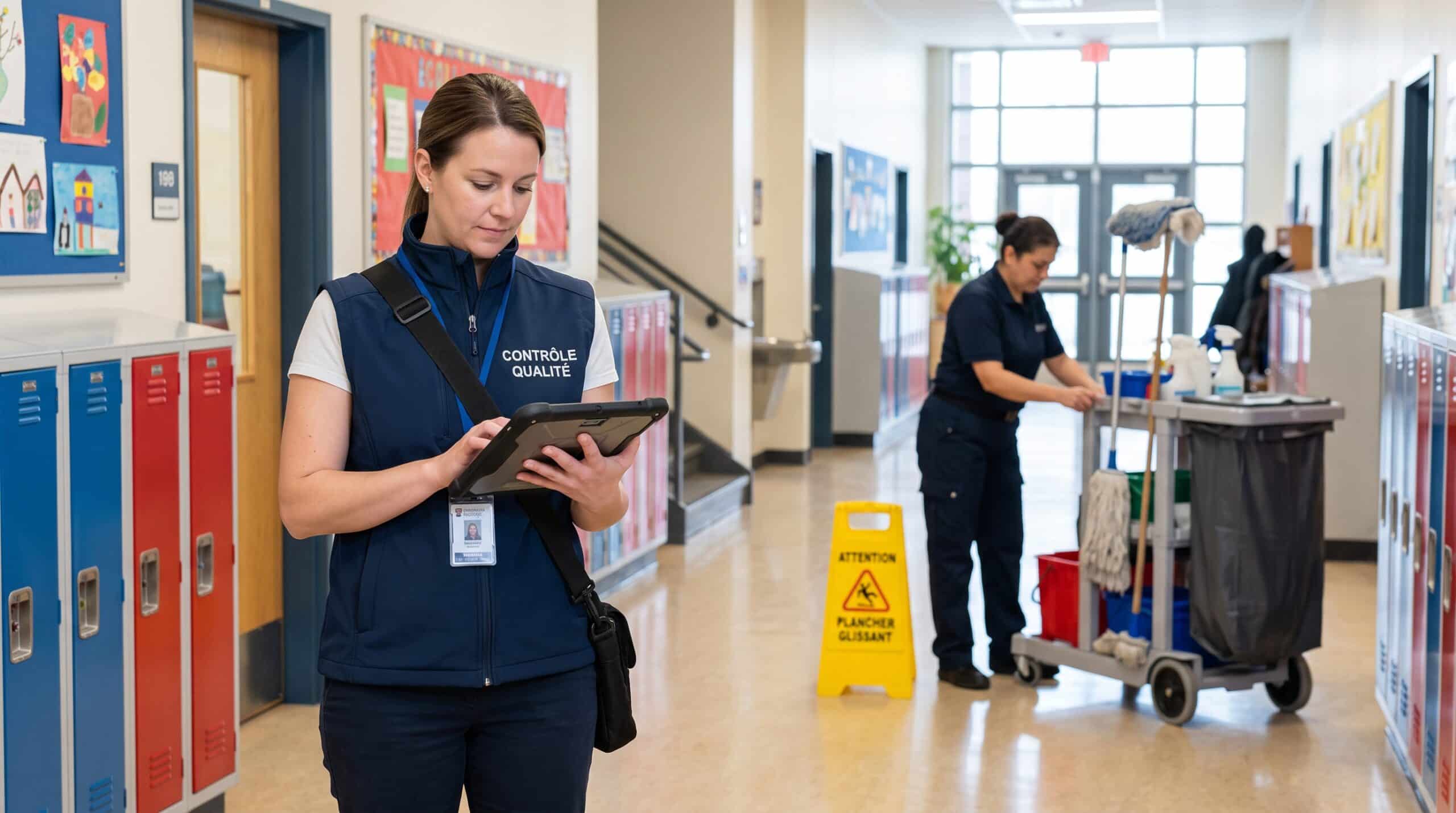

Quebec's cities and municipalities employ a large portion of their housekeeping staff for their recreational and sports buildings, as well as community halls and city halls. The city's entry point is like a laborer, and therefore serves as a springboard to other sectors such as heavy equipment, park maintenance, etc. As a result, the city often finds itself with unqualified employees or those uninterested in housekeeping. So, what can be done to improve the quality of housekeeping in a city or municipality under these circumstances?
Housekeeping issues in cities and municipalities
Small municipalities
- Lack of replacement employees. Indeed, small municipalities generally only hire one employee for all their buildings. So, when that employee is sick, on vacation, or has a work accident, there is no one to replace him or her. Here is an article from tips for times of labor shortage, hoping this is helpful to you.

Organize the spring cleaning of your buildings Working hoursSome buildings must be built during the day and others in the evening or at the end of the day. This difficulty must therefore be recognized before developing a long-term schedule.
- Periodic work. Typically, municipalities hire someone with little or moderate experience in housekeeping. And these people don't necessarily have the knowledge to do periodic maintenance of floors, carpets, furniture washing or windows. Here is an article onspring cleaning organization

Medium and large cities

Quality control and employee management Lack of time for management staffThe manager is not only responsible for housekeeping, but also for maintenance, technical services of the building as well as logistics between the different organizations.
- The interest of housekeeping staff. Since the workforce is applying for manual labor positions, they don't necessarily have the experience to do this job. And even more importantly, they are often not interested in this position; for them, it is a gateway to working in the city. So, as soon as a position becomes available in other fields, they can apply.
- Knowledge of supervisory staff. The latter generally has general knowledge of the building, but not necessarily related to housekeeping. Several have told me that they felt helpless in this area because they did not have enough in-depth knowledge on the subject. To this end, please know that we offer the quality control training and management of housekeeping employees.

Common issues for cities and municipalities
The condition of the buildings

Given the problems mentioned above, this generally leads to poorly maintained buildings or buildings with significant accumulations on the floors, for example. Stripping a floor that has been poorly waxed for 10 years will be very difficult to do and will require specific products, equipment, and techniques.
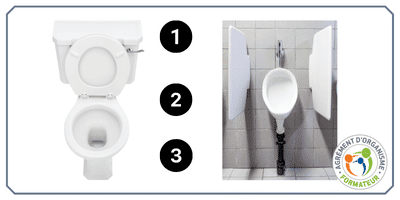
To this end, here is a list of 10 common non-conformities. It can even be said that certain non-conformities completely discourage employees. For example, this urinal was badly damaged by years of using corrosive products.
Lack of training

Since employees lack the knowledge to apply proper work techniques, they do what they think should be done. Typically, information is passed from one employee to another, who then receives it from another incompetent employee, and so on.
We must start with basic training (daily housekeeping). Commercial and industrial building maintenance is nothing like housekeeping. It's not a lack of commitment on the part of the employee; it's simply a lack of professional training.
View this article on everything that is possible in cities and municipalities
None work route
For some people, it's easy to know what needs to be done in a building. But what's clear to one person isn't necessarily clear to another. Expectations would benefit from being clear and put into writing and images. I've noticed that social media has significantly changed the way we read text. It's therefore preferable now to illustrate what's being said for better understanding.

Work sequence for cleaning the toilets What to do: The tasks to be performed, their frequency and time of day when the work must be done.
- Who? On the work route, which employee should perform this task?
- With: That is, the name of the product, accessory or equipment to be used.
- How to do it? There are a variety of ways to achieve a goal. For example, do we want it to be dusting? Washing? Brushing? Scrubbing? Stripping? It seems very important to me to define the words well employees. Cleaning doesn't mean dusting. It needs to be more specific than that.
- In what order? For example, when stripping, there are several steps to prepare the space before even applying a drop of product. And one of the most neglected tasks when stripping is sweeping! Since we want to strip, nothing should remain on the floor; we will have to remove the furniture. We should vacuum, rather than sweep or mop, and even under radiators.
- What finish do you want? Because you can polish, scrub, strip, brush, or wash a floor. But the results won't be the same. If the employee doesn't know how to decide which action to perform, it will be necessary to determine what elements to consider when making a choice. Does the employee know how to identify different floor surfaces? Because surfaces don't have the same restoration steps.
Wash floors safely To illustrate the point. It is proven that after 2 weeks, we retain:

- 10% of what we have read
- 50% of what has been seen, heard or demonstrated
- 90% of what we have read, heard, seen, experienced
- For example, the article we wrote for learn to dance with the mop is still very popular in training as well as in illustrated reminders on the wall.
Possible solutions
Of course, some buildings have been neglected for years. This isn't a priority for some city boards. Therefore, city managers have limited power in this regard. So, aside from renovations, here are some possible solutions:
- Restore at a lower price: With the Twiste tamponsr, you'd be surprised at how much flooring you could restore. In fact, this technique is done daily, simply by adding a special pad to the scrubber. Floor restoration is therefore done daily, without any additional action.
- Better equipped with high-performance equipment: There are plenty of great new innovations every year in the field of home maintenance. Here are a few of them, in our innovation section.
- Continuous training: There's nothing better than training to motivate employees to do better. Employees are always happy to see that they're finally being taken into consideration. But not onlydaily housekeeping is important, but also the stains of spring cleaning and of soil techniques. Employees also need to be given the necessary time. Don't expect employees to go and maintain their building after completing technical training; that's too much. Training requires concentration on their part.
- Take an interest in their situation. You'd be surprised how many employees are completely idle because they're used to people not being interested in their work situation. When an employee comes up with an idea, it's not uncommon for it to be completely ignored, especially in housekeeping. In this regard, we've illustrated this point in a blog post.
- Set clear expectations ! Write down and visualize the work to be done as well as the work routes. Don't assume that everyone thinks the same as you and that everything is clear.
So, I hope this article will help you find ways to improve quality. Please feel free to contact us. to consult if necessary, we are available for all cities and municipalities in Quebec.