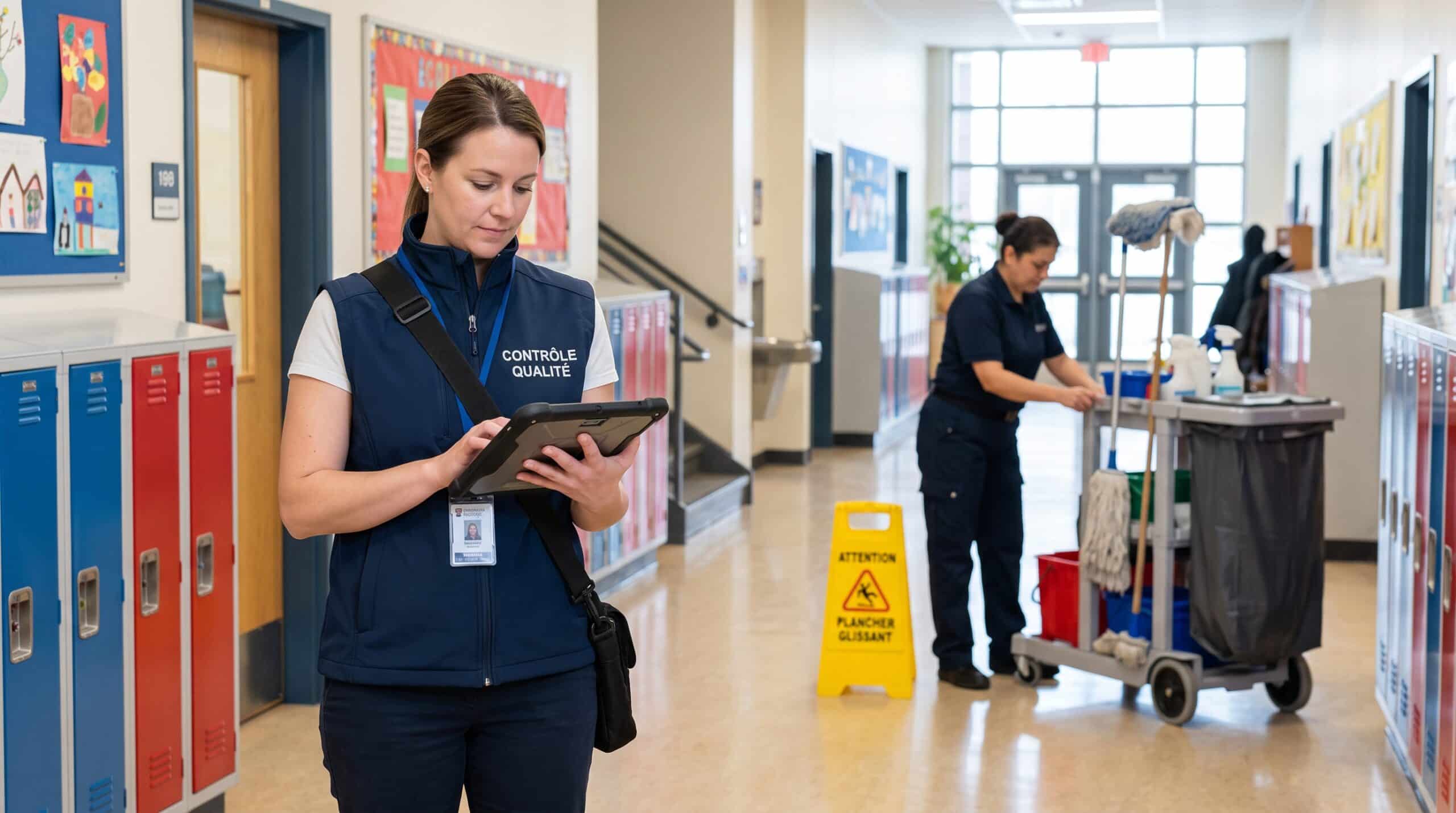

In a school, everything is constantly moving. Students come and go, eat, do crafts, play, move around, sometimes knock things over, forget papers, move chairs, and use the restrooms all day long. This is normal: a school is a living environment.
But because a school is a living, breathing community, school cleaning cannot rely solely on the evening shift. The quality of cleanliness depends on clear communication between the daytime cleaning team, the evening shift, school staff, administration, and students.
A clean school is therefore not just a matter of cleaning. It is a shared responsibility.
A clean school is a collective responsibility
The goal is not to ask everyone to do the concierge's job. Rather, it's about understanding that each person can either facilitate or complicate housekeeping.
For example:
- A cluttered classroom prevents effective cleaning.
- Offices cluttered with objects or stuck-on papers make surfaces difficult to clean.
- Cluttered floor space under desks, such as shoes or bags, prevents floor cleaning.
- A room used by several groups must be left in a reasonable condition.
The housekeeping team is responsible for cleaning all available and accessible areas. It's also important to remember that not all surfaces are cleaned daily. Some tasks are scheduled weekly, monthly, or according to another frequency specified in the maintenance contract.
The role of the daytime maintenance team
During the day, the maintenance team primarily ensures cleanliness in public spaces and high-traffic areas. They don't usually perform deep cleaning, but they respond quickly to keep the school functional, safe, and hygienic.
His tasks may include:
- Responding to emergencies: vomit, water damage, spilled liquid, bathroom accident.
- Monitor the toilet facilities, especially after breaks and meals.
- Check supplies: toilet paper, soap, paper towels.
- Keep entrances safe: water, snow, calcium, sand, saturated carpets.
- Empty some trash cans as needed, especially in the cafeteria and hallways.
- Communicate the problems to the evening team and management.
However, we must remain realistic. The day shift cannot constantly add tasks to the evening shift, which already has a heavy workload. In the event of major damage, a disaster, or an unusual situation, it may be necessary to temporarily add staff.
The role of the evening maintenance team
The evening team takes back control of the building once the students have left. It is at this point that structured cleaning can actually take place.
According to the housekeeping quote, their responsibilities may include:
- The classrooms: contact points, waste bins, mopping, floor washing according to the scheduled frequency.
- Toilets, changing rooms and showers: furniture, floors, bins and periodic tasks.
- Food areas: floors and garbage cans when these tasks fall under housekeeping.
- Corridors and entrances: mopping, floor washing, entrance mats, windows and furniture.
- Administrative areas: bins, floors and cleaning on a rotating basis.
As you can see, the evening shift already has a full workload. Unforeseen events must therefore be handled judiciously. If a situation exceeds the team's normal capacity, reinforcements should be brought in rather than adding to an already full workload.
The night shift
In CEGEPs and universities, a night team is necessary. This team is generally assigned to cleaning the sports area, the cafeteria, and the corridors occupied in the evening.
The role of school staff and students
Teaching staff, daycare staff, educators, supervisors and activity leaders play an important role in maintaining the spaces.
A few simple actions make a big difference:
- Encourage students to pick up their litter.
- Free up offices and workspaces.
- Keep the floors clear.
- Allow five minutes for tidying up at the end of the day.
- Report any damage or unusual situations promptly.
- Raising students' awareness of respecting the work of caretakers.
A tidy room allows the cleaning staff to do a proper clean. It's also a great way to teach students to respect common areas.
The role of management
Leadership is a cornerstone. If the cleanliness of the school is considered important, several concrete decisions will follow.
Management can contribute by planning ahead:
- Purchasing professional equipment, accessories and products.
- Rapid repair of faulty equipment.
- Clean, safe and functional housekeeping facilities.
- Balanced work routes.
- A clear schedule of daily, periodic and monthly tasks.
- Recognition of the maintenance teams.
- Realistic planning of activities and locations.
- Good communication between the teams.
Respect also extends to working conditions. For example, during summer maintenance, some schools shut off the ventilation. Yet, physically working in a hot, humid, and poorly ventilated building makes the job much more difficult.
Communication: the link between all teams
Communication is often what makes the difference between an overwhelmed team and a well-organized one.
Several methods can help:
- A communication log between teams.
- Clear work routes.
- Periodic task lists.
- Regular team meetings.
- A quality control check with photos.
- Follow-up on non-conformities.
- Additional training when necessary.
Joint meetings can also reduce tension between teams. It often happens that the evening team thinks the day team isn't doing anything, while the day team counters that the evening team is working without students in the hallways. When teams get to know each other better, collaboration becomes more natural.
A good leader also plays a vital role. This person helps maintain cohesion, highlights successes, and guides areas for improvement.
The cleanliness of a school does not depend on a single person or a single shift. It depends on the cleaning staff, the school personnel, the administration, and the students.
In conclusion, when everyone understands their role, housekeeping becomes less burdensome, more efficient, and better respected. Above all, it contributes to something fundamental: providing a healthy, safe, and welcoming environment for the entire school community.