

You will save money by doing preventive maintenance on equipment
Why is it so important to take care of our cleaning equipment and accessories? So that they don't have to be replaced prematurely and so that they remain efficient. All cleaning equipment is good for years, but it depends on whose hands they've been in! So here's a preventative equipment maintenance guide that you can even share with your employees.
Maintenance of accessories
Wash cloth
Microfiber should be washed separately, with regular laundry soap, but without fabric softener, which would limit its range of uses. And since it has a strong electrostatic effect, if you washed it with other materials, they would stick to the cloth.
Wash other cloths together, keeping the colors separate. Also, do not mix fabrics that have been in contact with grease or oil. You should replace your wash cloths daily with clean ones.
Floor mop
Mops can be washed regularly. However, I wouldn't mix any other fabrics with this type of material. You could let them air dry to save energy. However, make sure to empty your washing machine's waste receptacles regularly. This type of fabric leaves a lot of lint. Note that every user should vacuum their mop after use. This will make washing easier and save the mop washer a lot of trouble! Imagine having to wash dirty mop bags full of dust and hair?!
For those who are looking for washing mops, you can also wash them in the washing machine, but make sure to buy mops with attached ends. Otherwise, the strands will get tangled and will be difficult to reuse.
Flat mops should be washed separately as with microfiber wash cloths.
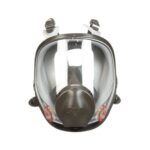
Goggles, safety helmet, mask, boots
These should also be cleaned with water and a light cleaner. Note that we offer the training on washing masks rReusable respirators. Your work boots, shoes, or booties must be cleaned to avoid contaminating the surface with dirt stuck to your soles. Note that this is required every day in food factories.
Brushes, brooms and dustpans
Remove excess dirt first. Afterward, you can wash the head in a tub with water and a cleaning agent. The cleaning agent you use will depend on what you've cleaned with the tool. For example, if you've been sweeping a warehouse, it would be appropriate to wash it with water and a degreaser.
After washing, rinse your brooms and brushes with clean water and let them air dry. Note that in the food industry, this task may be required daily in some buildings.

Floor and baseboard pads
Rinse them with clean, warm water immediately after use to remove or dissolve the residue. You can then reuse your tampons several times.
Bottles and sprays
Over time, the drain can become clogged. Simply soak your bottles and sprayers in warm water. This will loosen the dirt and your sprayer will be as good as new! As for bottles, remember that every time you change products, you should wash and rinse your bottles and sprayers to avoid health and safety issues related to mixing products.
Garbage container, recycling
Depending on the material being collected, you will generally need to wash your containers regularly with water and degreaser. Rinse afterward. If an odor persists, don't hesitate to apply an odor-eliminating product. Here is an interesting article on the odor treatment.
Equipment maintenance
Housekeeping trolley
First, your cart should be tidied up and given a quick cleaning after each use. This only takes a few minutes. Your dirty gloves and trash should be thrown away. You should even prepare it for the next day by restocking your sanitary supplies, for example. Ensure that your laundry products are restocked if necessary. Here's an article on What your housekeeping cart should contain, depending on the work route assigned to you.
Wipe down your main equipment. After all, you can't clean with dirty equipment. Never leave dirty water in the boilers or even prepare them by filling them with your product for the next day. The cleaning solution would then no longer be effective. Simply rinse the boilers and wipe them down.
Vacuum cleaners
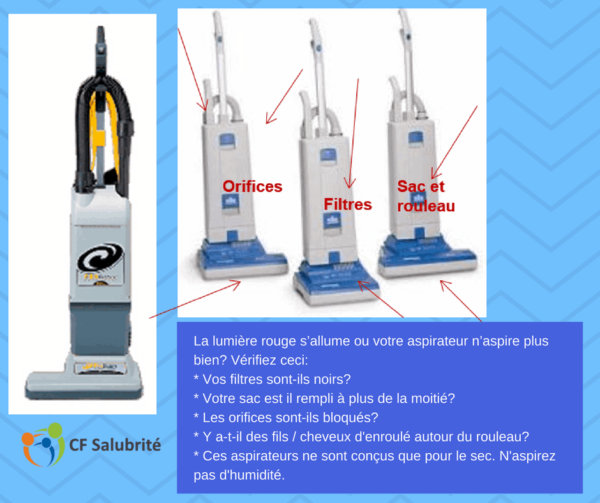
Here's an image summarizing the main points to watch for and correct. Also, keep in mind that upright vacuums aren't designed to handle wet carpets in winter. You risk burning out the motor prematurely, rendering the unit unusable. For this, you'll need a wet/dry vacuum.
Floor polisher (low or high speed)
Check its operation and the condition of the wire before use. It should not be twisted or nicked. Remember that you are working in water, so do not use equipment with such wires; have them repaired beforehand. In addition, any screws or nuts must be tightly tightened. There are also 'splash guards' installed on these equipment to prevent material from splashing everywhere. If you remove them, be aware that the material could splash not only on your equipment, but also on the walls. Never leave the attachment pad (Driving pad) or brush on the equipment, as this will deform it. Also, rinse it after use and wipe dry.
If you see a crack in the base, handle, or any other part of the equipment, stop using it and have it repaired. Also, if the electrical cord is nicked, do not use it. You are still working in the water.
Clean your equipment immediately after use. If your equipment gets dirty quickly, it will be more difficult to clean.
Carpet or furniture extractor
Rinse your tank, filter, hose, and equipment exterior thoroughly after use and wipe dry. If an odor problem persists, you can use an odor control product. Never leave any material or water (dirty or clean) in the equipment. This allows bacteria to thrive, creating unpleasant odors and other unpleasant effects.
Floor scrubber
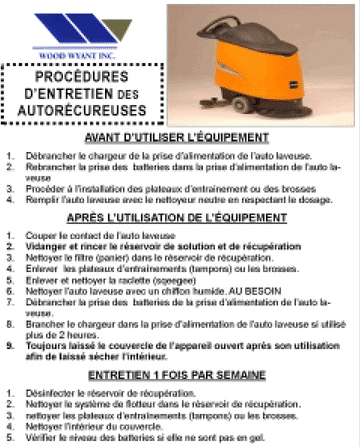
Same maintenance as for carpet or furniture extractors. In addition, you will need to leave the tank cover on. OPEN to let the batteries breathe. Otherwise, you will contribute to premature battery burnout. You may have to do some maintenance on the batteries depending on the type of batteries you have (maintenance or maintenance-free). More and more suppliers are selling this type of equipment with maintenance-free batteries. They are more expensive, but you will save in the long run on the longevity of your batteries. Here is a tutorial that I had from an equipment repairer Wood Wyant, Stéphane (the best equipment repairer I've ever had!)
Finally, if there is any missing equipment or accessories, please let me know; I will be happy to adjust my article. I give you permission to distribute this article to your coworkers and employees. Provided you do not alter the article and provide credit for its origin.
This article follows another listing the types of housekeeping equipment
Additional articles to this article
- Prevent, repair or change the equipment?
- Maintaining a scrubber
- Types of scrubbers and their maintenance
- Preventive maintenance of pure water washing equipment


