«My building is not clean and I am receiving complaints.» That's often how the call begins.
The manager on the other end of the line doesn't really know where the problem lies. He tells me that his employees have been there a long time, or conversely, that some have just arrived. He has the impression that they lack nothing. But he senses that something is missing: methods, structure.
And he's right. In the vast majority of cases, the problem isn't the employee. It's rather the lack of a framework for effective work.
In short: When a building isn't clean despite having a team in place, the cause is rarely employee unwillingness. More often than not, they've never been trained, there are no work routes or written procedures, the employees themselves train new ones, and the products, accessories, and equipment have never been evaluated. Before changing teams or subcontractors, a thorough assessment is necessary.
The 4 causes I find most often
It's by asking questions that I eventually understand what's going on. And from one building to another, the answers are almost always the same.
1. The employees have never received training
Many cleaning staff have never received proper training. They do their best with what they know. But cleaning is a skill that can be learned: the order of tasks, the right product for the right surface, the contact time of a disinfectant, and the techniques that prevent spreading dirt from one room to another.
Without these foundations, you can work hard… and still end up with a building that isn't clean.
2. There is neither a work route nor a written procedure
Quand rien n’est écrit, chaque employé décide lui-même quoi faire, dans quel ordre et à quelle fréquence. Résultat : Les employés font certains locaux deux fois, et d’autres sont oubliés et personne ne sait vraiment ce qui devrait être fait.
A work route Claire tells everyone what they need to do, where and when. It's also the only way to check afterwards if the work is actually done.
3. It is the employees who train the new ones
This is probably what I see most often. A new employee arrives and is paired with someone experienced. The intention is good. But the experienced employee brings their own way of doing things, with their good habits… and their bad ones.
And he himself learned it from someone else, who also hadn't been trained. Over the years, methods change, and everyone ends up working in their own way.
4. The products have never been evaluated.
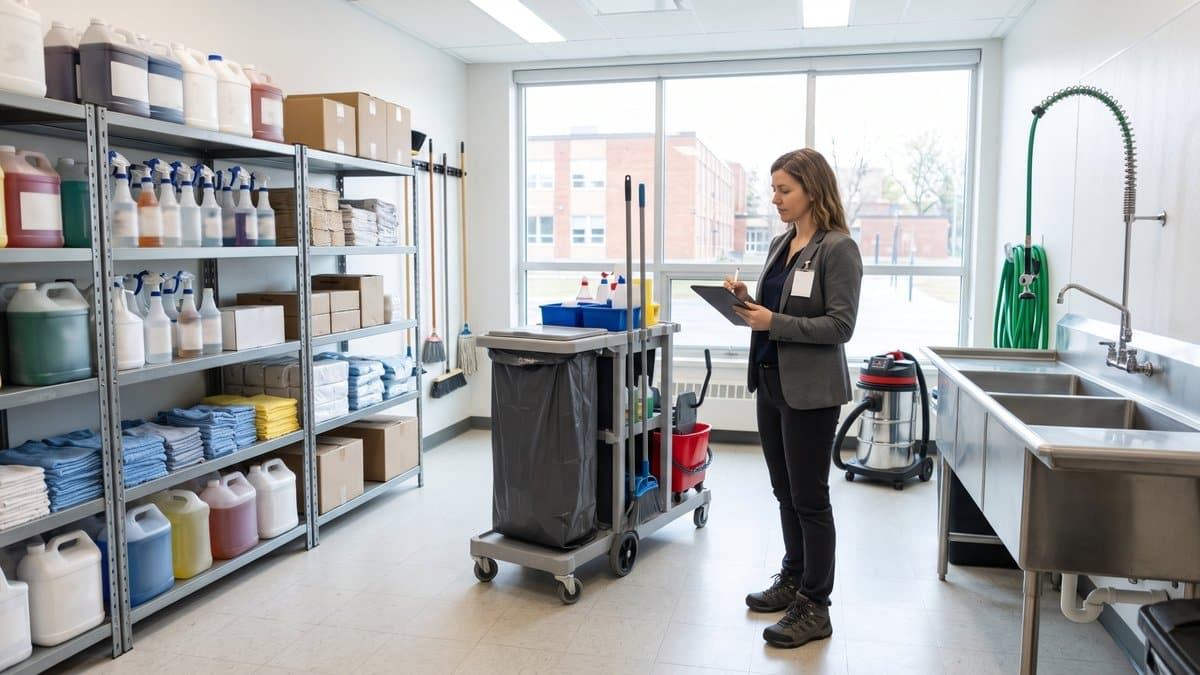
Dans le local de conciergerie, je trouve souvent une panoplie de produits. On commande ce que les employés demandent, sans que personne ait déjà évalué si ce sont les bons. Il y souvent des accessoires de type résidentiel qui ne sont pas formulé pour le domaine commercial ou industriel. Et parfois, il manque carrément d’accessoires efficaces.
And there is no dispenser : chacun dilue « à l’œil ». En fait, trop de produit laisse des résidus collants qui attirent la saleté. Et pas assez de produit laisse une surface mal nettoyées. Sans compter qu’on paie pour des produits qui font double emploi.
Why doesn't the manager see the problem?
De l’extérieur, tout semble en place : l’équipe est présente au travail et les produits sont commandés.
Le gestionnaire a souvent un bagage en gestion mais pas en entretien ménager. Ce n’est pas un reproche : ce n’est juste pas son métier. Et c’est justement pour ça que les plaintes s’accumulent sans qu’on sache par où commencer.
Where to begin
- Make a diagnosis before taking action. I always start by asking questions, to the manager and the employees, then I visit the premises and the concierge's office. Changing teams or subcontractors without understanding the cause often means repeating the same problem with other people.
- Train the whole team at the same time, using the same methods. A group training, In your own facilities and with your own equipment, it gets everyone on the same page, both new and returning employees. As CF Salubrité is an accredited training organization, some organizations may be eligible for a grant from Services Québec.
- Write down the work routes and procedures. What is written down can be taught, followed, and improved. And a new employee learns the right method from day one. And the simpler the route is written and illustrated, the better.
- Clean up the products. Keep the right products, eliminate duplicates and install dispensers so that the dilution is always the same.
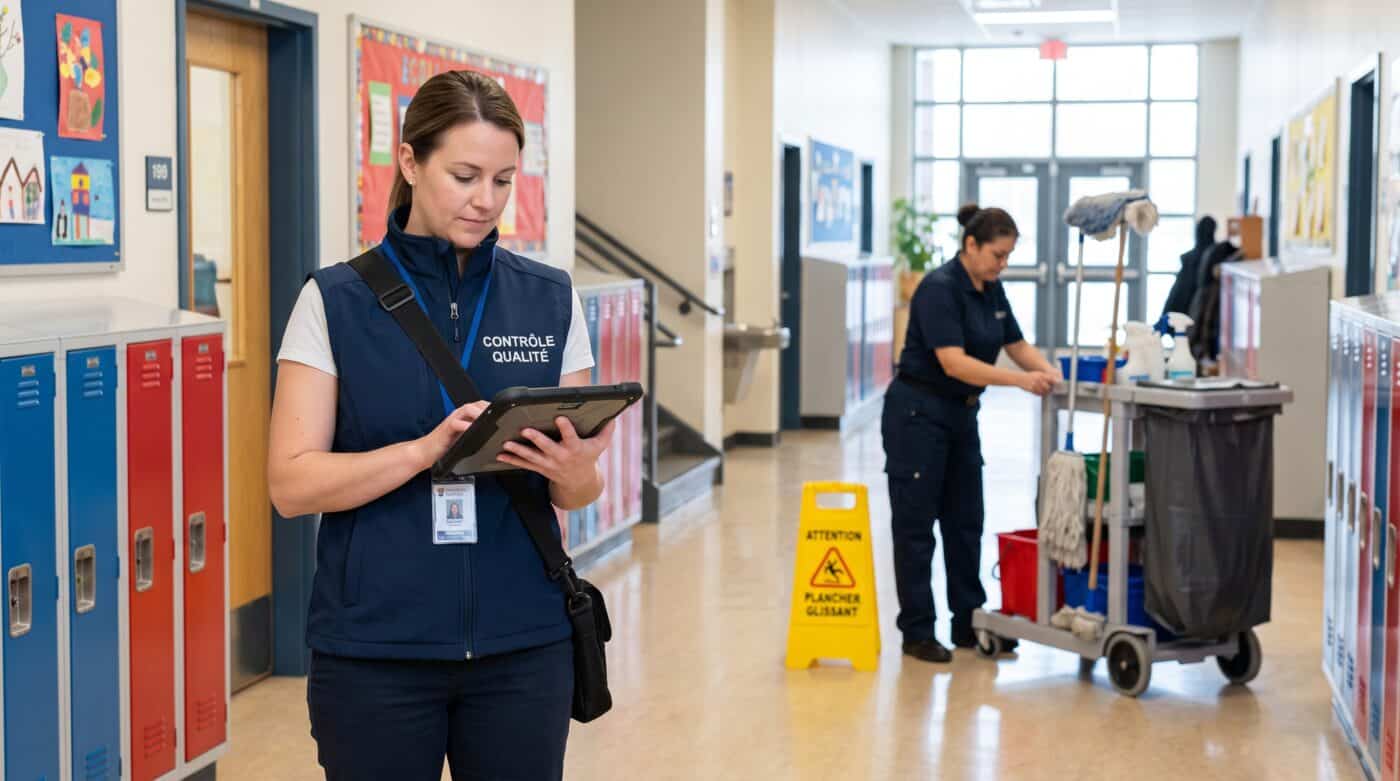
- Follow up. A quality control Regular check-ins allow us to see if the changes are lasting. At each visit, I focus on a maximum of three points with the employee, so they can improve a little at a time. I discuss this in more detail in Housekeeping quality control: Is your building clean?
Frequently Asked Questions
Why is my building not clean when my employees work hard?
Because working hard is not enough without a method. Without training, without a work route and with poorly dosed products, efforts are misdirected: some premises are done twice, others forgotten, and surfaces are not cleaned as they should be.
Should we change our maintenance team or subcontractor?
Not before a diagnosis has been made. If the cause is a lack of structure, a new team will face the same problem. In many cases, the existing team can perform very well, once trained and supervised.
Do my experienced employees really need training?
Often, yes. Experience doesn't guarantee good methods, especially when they've been passed down from one employee to another for years. Joint training also allows everyone to work in the same way. And I suggest that the person who manages the team be present at the training.
In conclusion
A building that isn't clean is rarely a matter of ill will. It's almost always a structural issue. And the good news is, it can be fixed.
Do you recognize your building in this article? Contact us to talk about it. I like to start by understanding your situation before suggesting anything.