

Here are 5 principles for safe surface maintenance
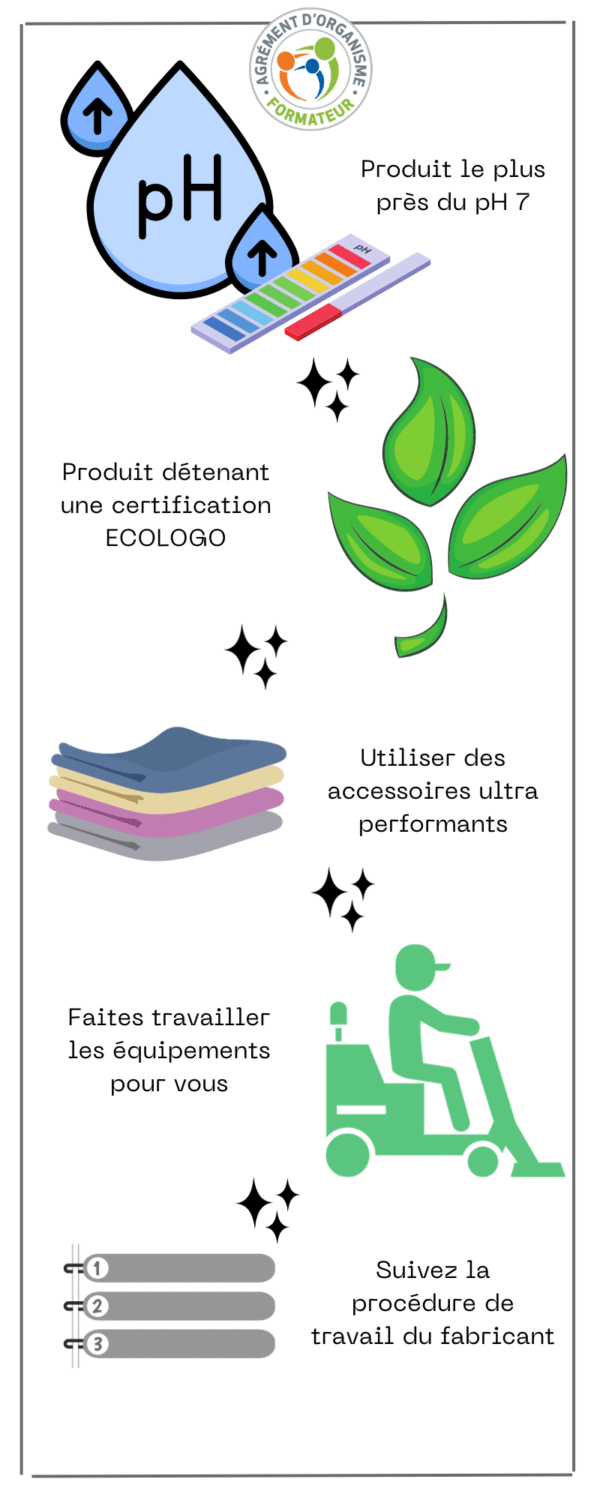
Use a household cleaning product that is as close to pH neutral as possible.
Household cleaning products that are too acidic or too alkaline can damage surfaces and the materials used for cleaning. By using a pH-neutral product, you can clean effectively while reducing the risk of damaging surfaces.
Furthermore, some household cleaning products can be harmful to your health. Always remember to follow the instructions on the product label and wear protective gloves when necessary.
On this subject, you will appreciate our blog post on the pH scale. For your quick reference, biotechnological products are generally formulated at a neutral pH.
Use recognized household cleaning products with a certification
Certified products have been tested for their effectiveness, as well as their impact on the environment and human health. This means you can be confident they will work as intended, without harming your health or the environment.
Certifications are issued by independent bodies that evaluate products according to strict standards. You can therefore rely on the quality of certified products.
Discover what a product with ECOLOGO certification is. Furthermore, by using recognized products sold in Quebec, Canada, manufacturers will have to comply with the regulations of WHMIS 2015. In Canada, the products are subject to certain rules as outlined in this Gazette article
Use a washing attachment to achieve effective mechanical force.
The cleaning accessory should be chosen according to the surface to be cleaned. It must be soft enough to avoid scratches or damage, while still providing effective mechanical force.
If you're cleaning delicate surfaces, such as wooden furniture or electronic screens, it's recommended to use a soft microfiber cloth. For more robust surfaces, like floors or walls, you can opt for a firmer brush. However, be sure not to use abrasive products that could damage the surface.
By choosing the right washing accessory, you can clean effectively while preserving the quality and durability of your surfaces.
Specialized equipment for efficient cleaning
Make sure you equip yourself properly so that the equipment works for you!
For example, you can use:
- a self-scrubbing machine, designed to clean with clean water and provide constant mechanical force;
- polishers, which work for you without requiring significant physical effort;
- high-performance microfibers, which improve cleaning efficiency.
Follow the procedure recommended by the manufacturer.
The manufacturers have tested the many possibilities of their products and equipment for us. They know their limitations, effective dosages, and best methods of use.
Following their recommendations helps prevent damage to surfaces and equipment, and can even harm our health. It's also essential to ensure that the product or equipment is suitable for the surface being cleaned. All products and equipment have their advantages, disadvantages, and limitations.
Where can you find the work procedure and the recommended dilution? On the product label, on the workplace label, on the safety data sheet or on the equipment technical data sheet.
Maintenance principles
Certain maintenance principles guide our actions logically, for example:
- Clean from top to bottom. For example, start with the highest surfaces and finish with the floors. This avoids having to start over because of dust that might fall.
- Choose a direction for your work and stick to it. Whether you work to the right or to the left, the important thing is to always follow the same routine. This helps reduce the risk of missing a surface or area that needs cleaning.
Hopefully these few principles will be helpful!


